
Synthetic Data for Test Data Management: Solving AI Development's Hidden Bottleneck
Test data scarcity is the hidden bottleneck blocking AI teams from shipping.

Puneet Anand
Tue Feb 10
Synthetic data is reshaping how engineering and AI teams think about test data, and DataFramer sits at the center of that shift.
The Hidden Bottleneck in AI Development
Every AI system, machine learning model, and data-driven application depends on one thing before it can be tested: data. Specifically, the right data: diverse, realistic, and safe to use.
This is where Test Data Management (TDM) has historically struggled. Teams building production-grade systems face a paradox: the real-world data that would make tests meaningful is often too sensitive, too sparse, or too expensive to collect and prepare. Privacy regulations tighten the window further. The result? Teams either skip rigorous testing, use stale or incomplete datasets, or spend months in data-preparation cycles before meaningful work can begin.
DataFramer addresses this paradox head-on.
What Is Test Data Management?
Test Data Management is the discipline of creating, maintaining, and governing the data used across the software testing lifecycle. In AI/ML contexts, this means ensuring that:
- Models are tested against realistic, representative scenarios, including rare or adversarial ones
- Sensitive data (PII, PHI) is never exposed in non-production environments
- Datasets are balanced and fair, not skewed toward majority classes
- Data preparation is fast and reproducible, not a months-long manual endeavor
Achieving all four consistently with real production data is often difficult and resource-intensive. That’s the gap synthetic data was built to fill.
In traditional software testing, teams focus on whether code behaves as expected under known conditions. In AI systems, the challenge is broader: teams must also test whether models behave well across changing distributions, rare cases, ambiguous inputs, and sensitive populations. That makes test data management more complex in AI than in conventional software workflows. The question is not only “Do we have test data?” but also “Do we have enough diversity, realism, and control in that data to meaningfully evaluate model behavior?”
What Is DataFramer?
DataFramer is a synthetic data generation platform and synthetic dataset generator designed to transform small examples of real data into large, statistically faithful, and privacy-safe datasets. It is purpose-built for teams developing and evaluating AI systems without having to expose or risk sensitive production data.
Unlike scripted generators or raw LLM prompting, DataFramer grounds generation in the statistical reality of your own seed data, learning distributions and structure from a handful of examples rather than requiring you to define everything upfront. For a full breakdown of what that means in practice, see how DataFramer works.
The Three-Step Process
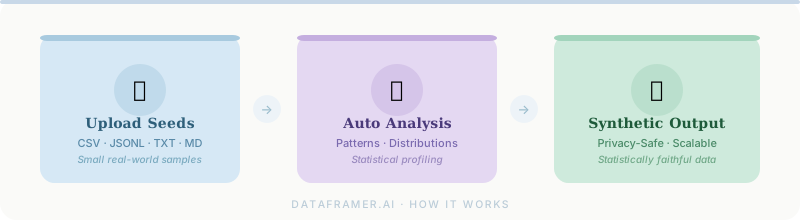
The platform operates in a clean, three-stage workflow:
- Upload Seed Samples: Provide a small set of example data in formats like CSV, JSONL, TXT, or Markdown.
- Automatic Analysis: DataFramer analyzes the data’s statistical properties, distributions, and axes of variation.
- Generate Synthetic Data: New datasets are created that mirror the fidelity of your originals while reducing privacy risk and preserving useful statistical patterns.
This process means even a small team with limited labeled data can use DataFramer as a test data generator to produce large, production-grade test datasets in a fraction of the time it would take to collect or annotate them manually.
Synthetic data is especially valuable when teams need to expand coverage, reduce exposure to sensitive records, generate rare or underrepresented scenarios, or move faster than real-world collection allows. In those contexts, it can help teams create safer and more scalable testing workflows. Its value is often highest when the bottleneck is not raw model training alone, but evaluation, QA, regression testing, and scenario coverage.
The TDM Challenges DataFramer Solves
The four most persistent pain points in Test Data Management map almost perfectly onto what DataFramer was built to address.
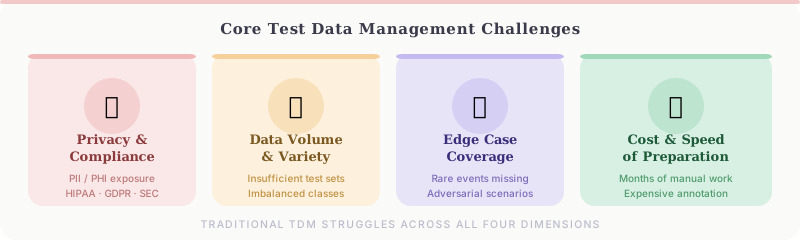
1. Privacy & Compliance
In regulated industries such as healthcare, finance, and insurance, using real customer data in test environments is a compliance risk. HIPAA, GDPR, SOC 2, and SEC regulations all impose strict controls on how data is used and where it flows.
DataFramer supports data anonymization and de-identification techniques that preserve statistical fidelity while removing PII and PHI from generated records. Enterprises in healthcare, finance, and government can enable testing workflows that reduce or avoid reliance on production data. This is not just a convenience. In many contexts, it is a legal requirement.
2. Data Volume & Class Imbalance
Effective testing requires more data than most teams have. Real-world datasets are also notoriously imbalanced: fraud cases are rare, medical conditions are uncommon, and edge behaviors are, by definition, infrequent.
DataFramer expands tabular datasets with realistic synthetic records that mirror true numerical distributions and automatically correct gaps and imbalances. For teams building anomaly detection, risk scoring, or classification models, this is transformative. Rare events and minority-class examples can be generated on demand, directly strengthening test coverage.
3. Edge Case & Adversarial Scenario Coverage
A model that passes standard tests but fails on edge cases isn’t production-ready. Generating those edge cases manually is tedious, inconsistent, and incomplete.
DataFramer simulates adversarial and rare scenarios programmatically, including multi-turn dialogue stress tests for conversational AI, complex document structures for NLP pipelines, and unusual input distributions for tabular models. This gives QA and ML teams confidence that their systems have been exposed to the long tail of real-world behavior before deployment.
4. Speed & Cost of Data Preparation
Traditional data collection and annotation pipelines can take months. DataFramer can significantly shorten data-preparation cycles while eliminating the cost of manual collection, licensing, and annotation. Because DataFramer attaches ground truth labels at generation time, dataset annotation becomes part of the synthetic data workflow rather than a separate step after collection.
Direct Alignment: TDM Need vs. DataFramer Capability
The alignment between TDM requirements and what DataFramer delivers isn’t coincidental. It’s structural.
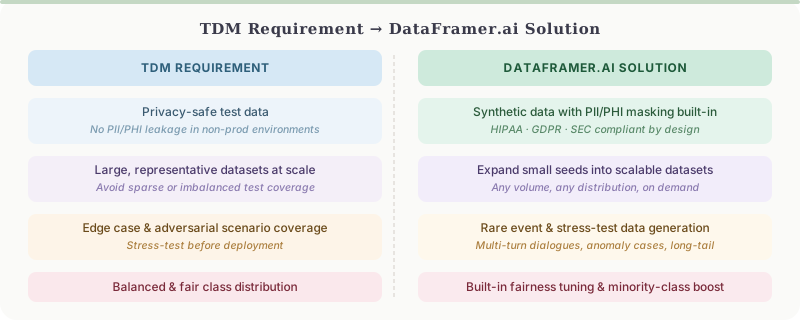
Every core requirement of a modern TDM practice has a corresponding DataFramer capability. This means organizations don’t need to bolt on synthetic data as an afterthought. They can build their TDM strategy around it.
Industry Use Cases
DataFramer’s alignment with TDM is particularly strong in data-intensive, compliance-heavy industries:
| Industry | TDM Use Case | DataFramer Application |
|---|---|---|
| Healthcare | Functional testing of EHR systems | Synthetic EHR data and patient records (PHI-free) |
| Finance | Fraud detection model testing | Synthetic transaction data with rare fraud patterns |
| Insurance | Underwriting model validation | Underwriting submissions with controlled edge cases |
| Conversational AI | LLM testing and chatbot regression testing | Synthetic multi-turn dialogue scenarios |
| Text Analytics / NLP | Document classifier testing | Synthetic long-form documents with labeled entities |
Governance, Fairness & Quality Controls
A TDM practice isn’t just about having data. It’s about having trustworthy data. DataFramer was designed with governance built in, not bolted on:
- Quality evaluation: Every generated dataset is pre-evaluated for statistical quality and can serve as a golden dataset or evaluation dataset for downstream model validation, with optional human expert review available for high-stakes workflows.
- Fairness tuning: Distribution controls let teams balance underrepresented groups and validate fairness during generation, a critical capability for responsible AI development.
- Compliance reporting: Audit-ready controls for regulated sectors, with deployment flexibility across AWS, Azure, GCP, or on-premise Kubernetes environments.
The Strategic Takeaway
Test Data Management is evolving. The old model of sourcing real data, scrubbing it manually, and hoping for coverage can’t keep pace with the speed of AI development or the tightening of privacy regulations.
DataFramer represents a modern approach to TDM: synthetic-first, privacy-by-design, and quality-governed. Its capabilities don’t just complement TDM best practices. They operationalize them.
For any team serious about testing AI systems responsibly, at scale, and in compliance with modern data regulations, DataFramer isn’t just aligned with TDM. It may be the foundation of what TDM looks like going forward.
LLM and Agentic Evaluation: Why Eval Dataset Coverage Matters More Than Size
The issue is rarely too few eval rows. It is eval data that misses the real spread of cases, slices, and failure modes.
Puneet Anand Why AI Projects Stall Between Prototype and Production
The demo worked. Now leadership wants confidence, coverage, and usable data before it ships to production.
Puneet Anand Reality-Grounded Synthetic Data Generation: Why Random Values Break Enterprise AI
Random values can fill a table. They usually cannot preserve how the table behaves.
Puneet Anand Get started
Ready to build better AI with better data?
The real bottleneck in AI isn't intelligence. It's the data you can't generate, can't share, or can't trust.